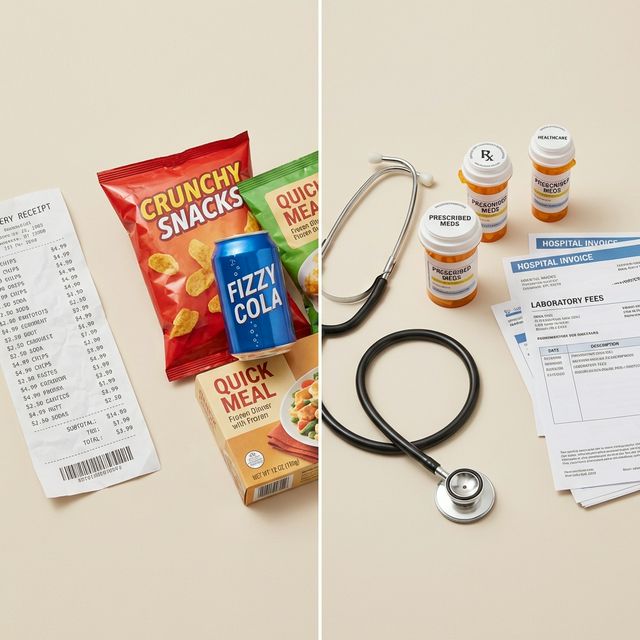
What if nearly half your grocery budget went to food that's making you sick?
That's not a hypothetical. According to research from NYU's School of Global Public Health, ultra-processed food accounts for 58% of calories consumed by American adults [1]. And calories roughly track with spending. When more than half your cart is ultra-processed, more than half your money is too.
Let's break down exactly where that money goes — and what it's really costing you.
The Numbers: A Typical American Grocery Budget
The U.S. Bureau of Labor Statistics reports that the average American household spends approximately $6,129 per year on food at home [2]. That's about $511 per month.
If 58% of that goes to ultra-processed food, we're looking at:
| Category | Monthly | Yearly |
|---|---|---|
| Ultra-processed food | ~$296 | ~$3,555 |
| Whole & minimally processed | ~$215 | ~$2,574 |
| Total food at home | ~$511 | ~$6,129 |
$3,555 per year on ultra-processed food. For a family of four, that number can easily double — crossing $7,000 annually.
Where the UPF Money Goes
Not all ultra-processed spending is obvious. Here's where it typically hides in a grocery budget:
| UPF Category | Est. Monthly Spend | Common Items |
|---|---|---|
| Packaged snacks | $45–65 | Chips, crackers, protein bars, cookies |
| Sugary beverages | $30–50 | Soda, energy drinks, flavored juice, sweet tea |
| Breakfast items | $25–40 | Cereal, flavored oatmeal, frozen waffles, pastries |
| Frozen meals | $35–55 | Frozen dinners, pizza, burritos, breaded chicken |
| Condiments & sauces | $15–25 | Bottled dressing, pasta sauce, ketchup, BBQ sauce |
| Deli & processed meats | $30–45 | Sliced turkey, hot dogs, bacon, sausage |
| Bread & bakery (industrial) | $15–25 | Sandwich bread, tortillas, hamburger buns |
Add it up and the numbers match: $195–$305 per month in ultra-processed food, often more. The sneaky part? Most of these items feel routine, not indulgent. Nobody thinks of sandwich bread as junk food — but most store-bought loaves have 20+ ingredients including high-fructose corn syrup and dough conditioners.
The Cost You Don't See: Healthcare
The grocery bill is just the beginning. Ultra-processed food consumption is directly linked to the chronic diseases that drive American healthcare spending.
A 2024 BMJ umbrella review analyzing 45 meta-analyses found that higher UPF intake is significantly associated with 32 adverse health outcomes, including [3]:
- Type 2 diabetes — the average annual treatment cost is $9,601 per person [4]
- Cardiovascular disease — average annual cost of $18,953 per patient
- Obesity — adds $1,861 in annual medical costs compared to normal weight [5]
- Depression and anxiety — treatment averages $3,000–$5,000 per year
You're not just paying $3,500/year at the grocery store. You're potentially paying multiples of that in downstream healthcare costs that never show up on a receipt.
The cheapest food in America isn't cheap at all. It's subsidized upfront and paid for later — in medical bills.
See your UPF vs. real food spending
Mount Dorito breaks down exactly how much you spend on ultra-processed food vs. whole food — from every receipt.
Try It Free →
The Myth of "Cheap" Processed Food
One of the most persistent myths about UPF is that it's cheaper than whole food. But is it?
| UPF Item | Cost | Whole Food Swap | Cost |
|---|---|---|---|
| Breakfast cereal (box) | $5.49 | Oats (canister, 2+ weeks) | $3.99 |
| Flavored yogurt (6-pack) | $5.99 | Plain yogurt (32oz) + fruit | $4.49 |
| Deli turkey (1 lb) | $8.99 | Rotisserie chicken (whole) | $5.99 |
| Bottled salad dressing | $3.99 | Olive oil + lemon + salt | $0.50/use |
| Frozen dinners (4 meals) | $15.96 | Rice + beans + chicken (4 meals) | $8.00 |
In most cases, the whole food alternative is the same price or cheaper. The convenience premium of ultra-processed food is a marketing illusion — you're paying more for industrial additives, not food.
3 Steps to Redirect Your Budget
You don't need to eliminate UPF overnight. Here's a practical approach:
1. See the split
You can't manage what you can't measure. Start by understanding what percentage of your grocery spending goes to ultra-processed food. Scan your receipts and look at the breakdown. Most people are shocked by their number.
2. Target your top 5 repeat buys
Don't try to overhaul everything. Identify your 5 most frequently purchased UPF items and find simple swaps. These high-frequency items have the biggest impact on your overall percentage and spending. (Our guide on 5 easy swaps is a good starting point.)
3. Track the trend, not the day
A single trip doesn't matter. Your monthly trend matters. If your UPF percentage is going down over time — even slowly — you're winning. And the spending follows.
Bottom Line
The average American household spends over $3,500 a year on ultra-processed food — and potentially far more in long-term healthcare costs. But the fix isn't complicated. It's just invisible until you track it.
Once you see where the money goes, the swaps become obvious. And unlike most budget advice, this one makes you healthier and wealthier at the same time.
Related Articles
- 5 Easy Swaps to Cut Ultra-Processed Food
- I Tracked My Cart for 30 Days — Here Are the Results
- What Is Ultra-Processed Food?
References
- NYU School of Global Public Health. "Ultra-processed food now accounts for 58% of calories consumed by U.S. adults." 2024.
- U.S. Bureau of Labor Statistics. "Consumer Expenditure Surveys." 2023.
- Lane MM, et al. "Ultra-processed food exposure and adverse health outcomes." BMJ, 2024;384:e077310.
- American Diabetes Association. "The Cost of Diabetes."
- CDC. "Adult Obesity Facts." Centers for Disease Control and Prevention.
Note: Cost estimates are illustrative and based on national averages. Individual spending varies by region, household size, and dietary choices. This article is for informational purposes only.
See where your grocery money really goes
Mount Dorito breaks down your UPF vs. whole food spending from every receipt.
Download Free